


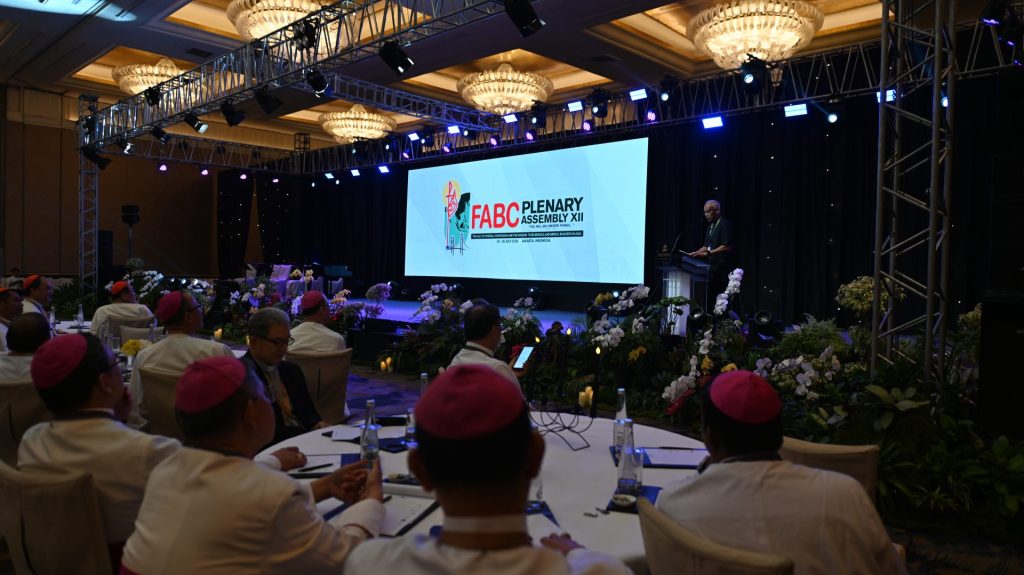
Representatives of regional bishops’ conferences from around the world voiced support for the Federation of Asian Bishops’ Conferences during its 12th Plenary Assembly in Jakarta, and described synodality as a way of being Church rather than merely a model of governance.
Delegates from Latin America, Africa, Europe, the Middle East, Oceania, and the United States highlighted communion, listening, reconciliation, and missionary discipleship. They encouraged the Churches in Asia to continue building bridges across cultures, religions, and societies.
Cardinal Jaime Spengler, OFM, archbishop of Porto Alegre, Brazil, represented the Latin American Episcopal Council, or CELAM. He said the Church was living through “a historic moment” in which Christians are called to discern what the Holy Spirit is saying to the local Churches.
“The newness that the Holy Spirit wishes to teach us is expressed through our choices and decisions,” Spengler said.
He said synodality builds on the vision of the Second Vatican Council through an approach centered on communion, participation, and mission.
Representing the Symposium of Episcopal Conferences of Africa and Madagascar, or SECAM, Cardinal Fridolin Ambongo Besungu, OFMCap, archbishop of Kinshasa in the Democratic Republic of the Congo, congratulated the FABC on its 12th Plenary Assembly and welcomed its focus on synodal conversion and bridge-building.
Ambongo said synodality is “not simply a method of working together but a way of being Church.”
He said believers must journey together by listening to the Holy Spirit and to one another, becoming credible witnesses of reconciliation and hope in a divided world.
Europe sees shared synodal journey
Archbishop Gintaras Linas Grušas of Vilnius, Lithuania, representing the Council of European Bishops’ Conferences, or CCEE, drew parallels between the synodal journeys of the Churches in Asia and Europe.
Grušas said both continents were seeking practical ways to implement the final document of the Synod on Synodality through renewed evangelization, stronger communion, and greater missionary participation.
Reflecting on the synod in Rome, he said bishops, priests, religious, and laypeople from around the world discovered that the Holy Spirit remains active in every local Church despite their different circumstances.
“Diversity is not an obstacle to unity,” Grušas said. “When we listen to the Holy Spirit, our different histories, cultures, and pastoral challenges become gifts that we can offer one another.”
He warned that the Church must resist building walls in a world increasingly marked by polarization and conflict. Instead, he said, it must become “the bridge that reconciles humanity with God and with one another.”
Eastern Catholic patriarchs identify three priorities
Representing the Council of Eastern Catholic Patriarchs, or CPCO, Patriarch Raphaël Bedros XXI Minassian described his participation in the Jakarta assembly as a sign of the “exchange of gifts” encouraged by the synod in Rome.
Minassian identified three priorities from the synod’s final document: Conversation in the Spirit, conversion of Church structures and processes, and unity that respects diversity.
The Armenian Catholic patriarch said authentic synodality requires spiritual renewal as well as greater transparency, accountability and institutional reform.
He also stressed that unity should not require uniformity.
“The harmony of differences enriches the whole Church and manifests the richness of the Holy Spirit,” Minassian said.
He urged each local Church to contribute its experience while remaining united with the universal Church.
Oceania comes to listen and learn
Father Christopher De Souza, secretary general of the Federation of Catholic Bishops’ Conferences of Oceania, or FCBCO, described his participation as both a privilege and an opportunity to learn.
He conveyed greetings from FCBCO President Archbishop Ryan Jimenez, who was unable to attend because he remained in the Northern Mariana Islands to assist communities recovering from a devastating cyclone.
De Souza said Oceania, though geographically vast and largely covered by the Pacific Ocean, has rich Indigenous traditions that have long practiced synodality through communal discernment.
“We come humbly to listen and to learn because we are, in many ways, your younger brothers and sisters,” he said.
De Souza expressed hope that the Church in Oceania could learn from the pastoral experience of the Churches in Asia and other regions.
U.S. bishop praises Asian Church
Representing the U.S. Conference of Catholic Bishops, Auxiliary Bishop Reynaldo Bersabal of Sacramento praised the vitality and pastoral experience of the Churches across Asia.
He conveyed greetings from the USCCB leadership and reaffirmed the solidarity of the U.S. bishops with the FABC.
Bersabal highlighted the contribution of Asian Catholics to the Church in the United States, saying Asian priests, religious, and laypeople had enriched Catholic life through their missionary spirit and spiritual traditions.
“The growing presence of Asian and Pacific Island Catholics in the United States is a visible sign of the Church’s universality,” he said.
Bersabal said the plenary assembly demonstrated how bishops from different nations, cultures, and languages could walk together, listen to the same Holy Spirit, and share the mission of proclaiming the Gospel.
The international delegates’ messages reflected the assembly’s theme, “The Call to Synodal Conversion and the Mission to Be Bridges and Bridge-Builders in Asia,” and showed the growing emphasis on synodality in the Church’s mission across regions.
Originally published on LiCAS.news